Renting a Toyota Tacoma with Kids in Japan: Is It Worth It?
Key takeaways
- A Toyota Tacoma is impractical for family travel in Japan due to narrow roads, tiny parking bays, and exposed luggage space.
- Japanese rental fleets rarely stock the US-spec Tacoma; the Toyota Hilux or spacious minivans like the Alphard are better matches.
- Mid-size or large minivans provide power sliding doors, flat floors, and weather-proof storage for strollers and kid gear.
Renting a Toyota Tacoma with kids for a trip to Japan is generally impractical, and in fact, you will rarely find the North American-spec Tacoma at Japanese rental outlets. For families exploring Japan, renting a domestic minivan like a Toyota Noah, Voxy, or Alphard is vastly superior because Japanese roads, parking spaces, and toll booths are built for compact or cab-over vehicles rather than wide pickup trucks.
If you love trucks and are picturing an epic outdoor family road trip through Hokkaido (北海道) or the Japanese Alps (日本アルプス), understanding how vehicle classes work in Japan will save you hours of driving stress, parking tickets, and travel meltdowns.
The Reality of Trucks in Japan: Tacoma vs. Hilux
The Toyota Tacoma is designed primarily for the North American market. If you try to book one in Japan, you will encounter the Toyota Hilux (トヨタ・ハイラックス) instead. The Hilux is Toyota's global mid-size truck sold domestically in Japan.
While driving a rugged 4WD truck through rural Japan sounds adventurous, traveling with children introduces unique logistical friction:
- Exposed Cargo Space: Most rental pickups come with an open bed. Stashing bulky family suitcases, folding strollers, diaper boxes, and travel cots in the back leaves them vulnerable to sudden rainstorms, highway road grime, and snow. Soft tonneau covers are rarely guaranteed on standard rental contracts.
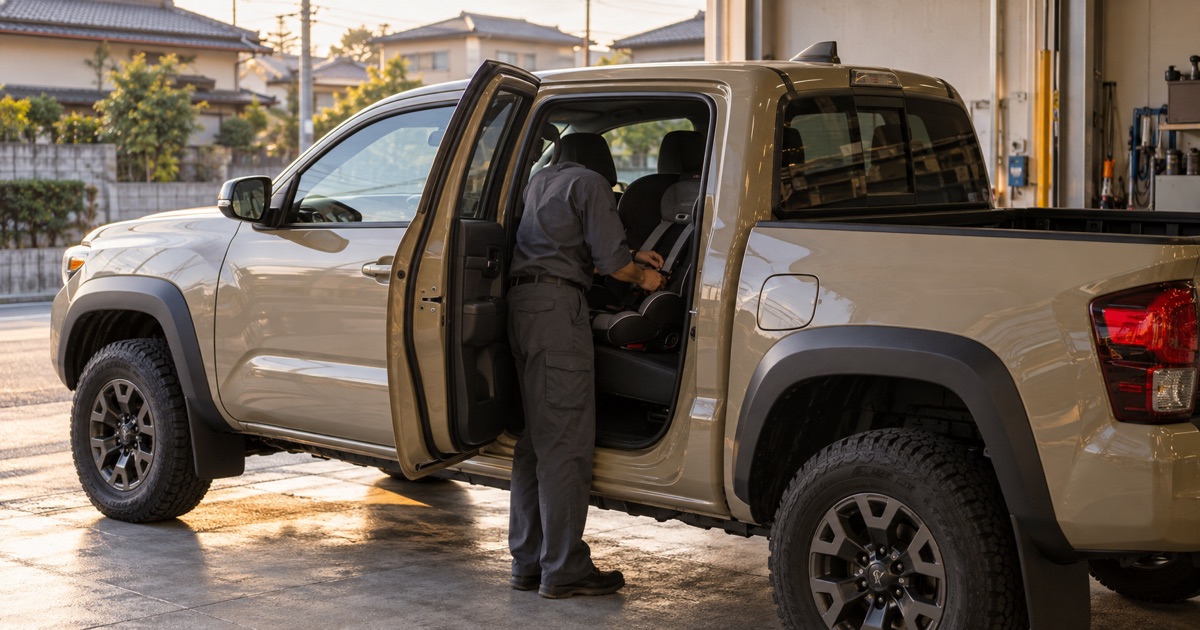
- Child Restraint System (CRS) Space: Japan legally requires car seats for children under six years old. The back seat of a double-cab pickup has an upright backrest, which can make rear-facing infant seats fit awkwardly and severely reduce legroom for the front passenger.
- Cabin Clutter: Unlike a family minivan, a pickup truck lacks pass-through cabins. If a toddler drops a pacifier, spills a drink, or needs a quick roadside diaper change, you must pull over completely, exit the truck in the weather, and climb into the back seat.
Driving Dimensions: Roads, Bridges, and Parking Garages
Japan’s road infrastructure was shaped centuries before modern oversized vehicles existed. Outside of major expressway corridors (kosokudoro / 高速道路), standard driving lanes are exceptionally narrow.
Parking Spaces (Chushajo / 駐車場)
Standard city and hotel parking spots in Japan measure roughly 2.5 meters wide by 5.0 meters long. A mid-size truck easily maxes out these dimensions. With normal hinged vehicle doors, opening them wide enough to extract a squirming two-year-old from a car seat without hitting the adjacent vehicle is nerve-wracking.
Furthermore, many urban hotels in Tokyo, Osaka, and Kyoto rely on mechanical tower parking (multilevel lift systems). These automated systems frequently impose strict vehicle width, height, and gross weight limits that mid-size trucks routinely exceed, forcing parents to hunt for expensive, distant open-air coin parking lots late at night.
Navigating Traditional Towns and Rural Byways
Driving through historic areas like Takayama (高山), Shirakawa-go (白川郷), or mountain villages involves streets with no sidewalks, blind curves, and deep concrete drainage ditches (gaiwa) running alongside the asphalt. A long-wheelbase pickup truck makes tight 90-degree turns around stone walls much more stressful than driving a flat-faced Japanese people-mover.
We are working to carry Japanese craft and everyday culture beyond Japan, by building Japan Towns with local partners.
Read the Japan Town plan →Best Family-Friendly Alternatives to the Toyota Tacoma
If you want Japanese reliability, all-weather capability, and plenty of space for the entire crew, consider booking one of these purpose-built alternatives through major services like Toyota Rent a Car, Times Car Rental, or Nippon Rent-A-Car:
1. The Compact Option: Toyota Sienta or Honda Freed
- Best for: 1 to 2 children with light luggage.
- Why it works: These compact wagons have low entry floors (easy for toddlers to climb into independently), dual sliding doors, and tiny turning radiuses. They fit into every standard parking stall in Japan while maintaining excellent fuel efficiency.
2. The Mid-Size Sweet Spot: Toyota Noah or Toyota Voxy
- Best for: Families of 3 to 5 people carrying strollers and multiple large suitcases.
- Why it works: These vehicles dominate family life in Japan. They offer flat walk-through floors, captain’s chairs in the second row that allow easy access to car seats, sunshades built into the rear windows for nap times, and power sliding doors that prevent kids from dinging adjacent cars. 4WD variants are readily available for winter road trips in Hokkaido or Nagano.
3. The Full-Size Luxury Hauler: Toyota Alphard or Vellfire
- Best for: Larger families or those wanting first-class comfort.
- Why it works: Massive interior legroom, whisper-quiet cabin acoustics for stroller-free naps on the road, deep trunk recesses, and elevated ride heights that give you the commanding view of a truck without the parking penalty of an open truck bed.
Practical Logistics: Car Seats, Tolls, and Navigation
Before setting off on Japanese roads with your family, prepare these essential logistics:
International Driving Permit (IDP)
Every adult who plans to drive must carry a physical International Driving Permit issued under the 1949 Geneva Convention, alongside their home country driver’s license and passport. Japanese rental offices strictly verify these documents before handing over the keys; digital scans or phone photos will result in an immediate refusal.
Booking the Right Child Seat
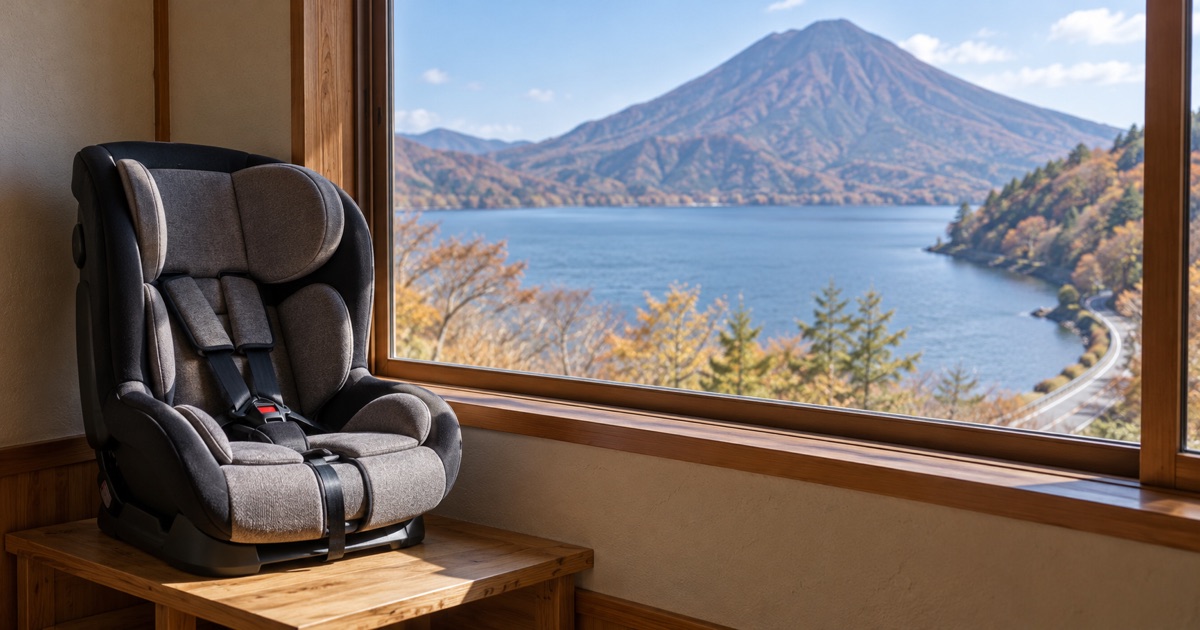
When booking your rental, you must reserve car seats in advance. Car seat categories in Japan generally follow weight and age brackets:
- Baby seat (ベビーシート): Rear-facing, newborns to roughly 12 months.
- Child seat (チャイルドシート): Front-facing with internal harness, roughly 1 to 4 years old.
- Junior seat (ジュニアシート): Booster cushion using the car’s seatbelt, roughly 4 to 6+ years old.
Check that the car seat is properly anchored before leaving the rental bay. Japanese rental staff can demonstrate the installation, but liability often requires the parent to clip and tighten the restraint.
Expressway Tolls and the ETC Card
Expressway driving in Japan is seamless but heavily tolled. Always request an ETC card (Electronic Toll Collection) from the rental agency. This card inserts into a slot inside the vehicle dashboard, letting you pass through highway toll gates at slow speeds without stopping to pay cash. The rental branch tallies your total usage when you return the vehicle.
Navigation and Transit Apps
While in-car navigation units (navitrons) are standard, entering Japanese addresses without reading kanji can be difficult. Ask the rental counter to switch the system language to English. Most car systems allow navigation via Japanese phone numbers (ten digits) or six-to-eight-digit "Mapcodes," which pinpoint specific rural trailheads, parks, and roadside stations (Michi-no-Eki / 道の駅). For real-time updates and detour planning around heavy traffic, keep Google Maps or Apple Maps running on a mounted smartphone.
Surviving Road Trips with Kids in Japan
Long drives with toddlers and young children are surprisingly painless if you use the country's dedicated roadside infrastructure.
Rely on Service Areas (SA) and Parking Areas (PA)
Expressways feature massive Rest Stops called Service Areas roughly every 50 kilometers. Unlike basic highway turnouts in other countries, Japanese Service Areas are family travel havens. They almost universally feature:
- Spotless, heated-seat public restrooms with child toilet seats and toddler wall-mount jump seats.
- Dedicated nursing rooms (akachan kyukeishitsu) with private nursing pods, changing tables, and hot water dispensers for baby formula.
- Food courts offering mild, kid-friendly meals such as plain udon noodles, rice bowls, and steamed buns.
- Outdoor green patches or play structures where kids can run off energy before the next driving stint.
Explore Roadside Stations (Michi-no-Eki)
When driving secondary rural roads instead of expressways, look for the blue road signs indicating a Michi-no-Eki (道の駅). These government-sanctioned rest hubs showcase local farmers' produce, regionally made ice creams, clean public toilets, and cultural gifts. They serve as reliable, low-stress pitstops to grab seasonal fruits, stretch little legs, and reset after unexpected road closures.
For up-to-date nationwide travel alerts and expressway conditions, consult the official resources provided by the Japan National Tourism Organization before mapping your daily route. For families combining self-drive segments with rail transport, check routes with JR East to smoothly bridge the gap between rural countryside driving and stress-free bullet train travel.
FAQ
- Q. Can you easily rent a Toyota Tacoma in Japan?
- A. No, the Toyota Tacoma is a North American market model and is not standard in Japanese rental fleets. Rental outlets offer the Toyota Hilux instead.
- Q. Is a pickup truck practical for family travel with young children in Japan?
- A. Generally no, because open beds leave luggage exposed to rain, cabin space is tight for car seats, and parking bays in Japan are very narrow.
- Q. What vehicle works best for families driving across Japan?
- A. Minivans like the Toyota Sienta, Noah, Voxy, or Alphard offer sliding doors, low floors for toddlers, and enclosed cargo space for strollers.
Cite or share this article
Copy the link below. If you quote this article, please link to this page as the source.